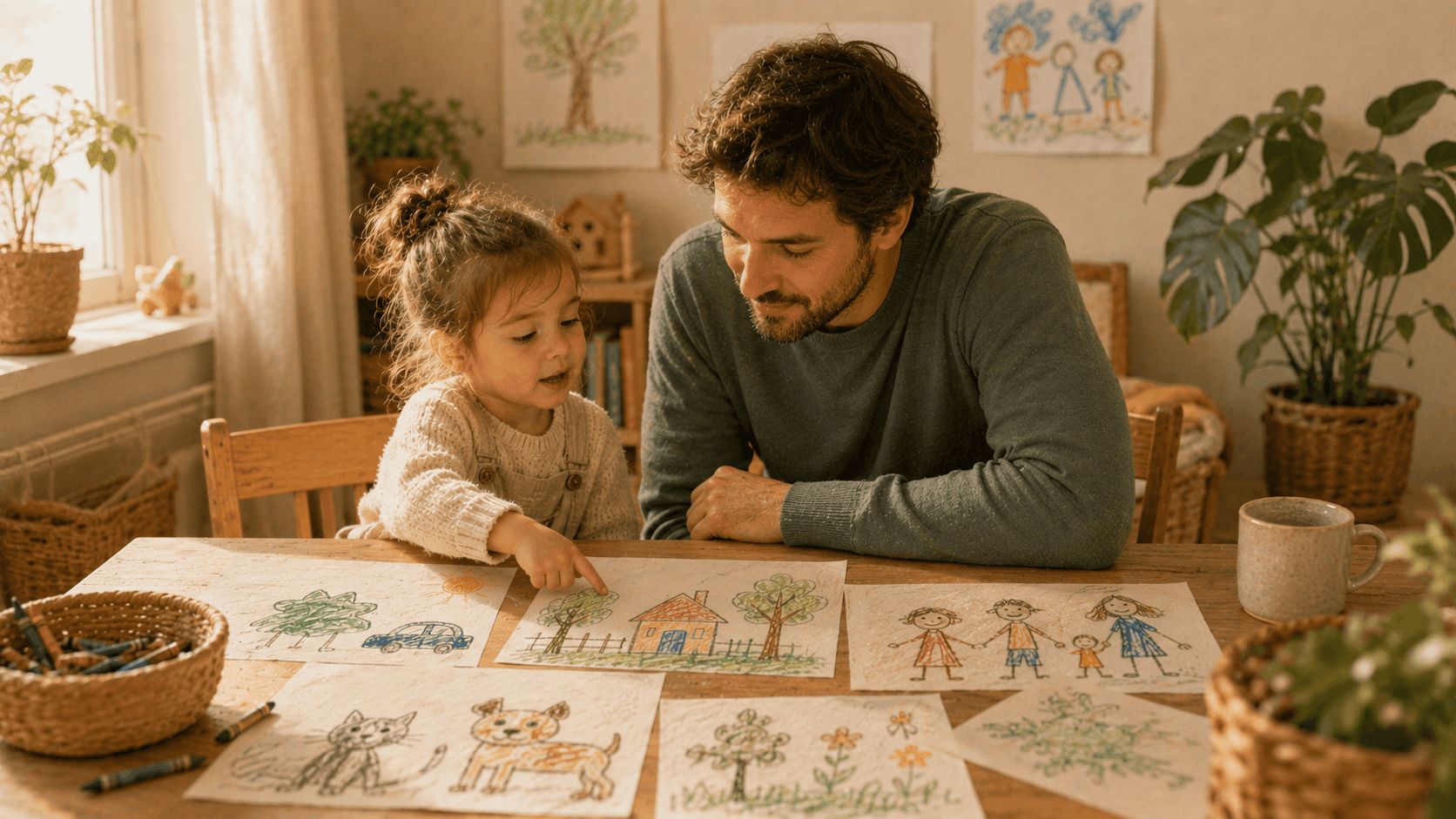
When a child hands you a drawing, it is easy to start searching for meaning right away.
Why is that person so small? Why is the sky dark? Why did they leave someone out?
But helpful observation usually starts with something much simpler: looking at the whole picture, listening to the child’s story, and resisting the urge to turn every detail into a clue.
Start With What Is Actually on the Page
Before asking what a drawing means, notice what your child chose to include.
Are there people, animals, places, favorite characters, or everyday objects? Is the picture telling a story, practicing a new skill, or repeating a familiar subject?
These basic observations are often more useful than trying to decode symbols.
Notice What Changes Over Time
One drawing gives you a moment. A collection of drawings can show development.
You may notice people gaining more details, stories becoming more complex, favorite subjects changing, or a child becoming more confident with shapes and color.
This is why drawing patterns over time are usually more useful than one unusual picture.
Pay Attention to the Story
A child may draw a monster because it is funny. A tiny person may be standing far away. A black sky may belong to a nighttime adventure.
The picture alone does not always explain the idea behind it.
Try asking, “Can you tell me what is happening here?” or “What happens next?”
Look at the Drawing Process Too
Sometimes the way a child draws is as interesting as the finished picture.
Do they spend a long time adding details? Draw quickly and move on? Tell a story while drawing? Return to the same subject for weeks?
None of these habits has one fixed meaning, but they can help you understand how your child enjoys creating.
What Parents Do Not Need to Do
You do not need to analyze every color, object, or missing detail.
Children experiment, change their minds, run out of space, copy ideas, and choose whatever crayon is nearby.
Our guide to common drawing interpretation mistakes explains why quick conclusions can be misleading.
What Parents Can Do
- Ask open questions.
- Save drawings from different months.
- Notice changes without judging them.
- Let the child explain the picture in their own words.
- Keep drawing enjoyable.
Key Takeaways
- Look at the whole drawing before focusing on one detail.
- Patterns over time are more useful than isolated pictures.
- The child’s own explanation matters.
- Observation is more helpful than trying to decode every symbol.
Frequently Asked Questions
Should parents analyze every drawing?
No. Most drawings are part of ordinary play, practice, imagination, and storytelling.
What is the most important thing to notice?
Context. Consider the whole picture, the child’s explanation, their age, and patterns across multiple drawings.
Should I ask why my child drew something?
You can, but open questions such as “Tell me about this picture” often feel less leading and invite a fuller story.