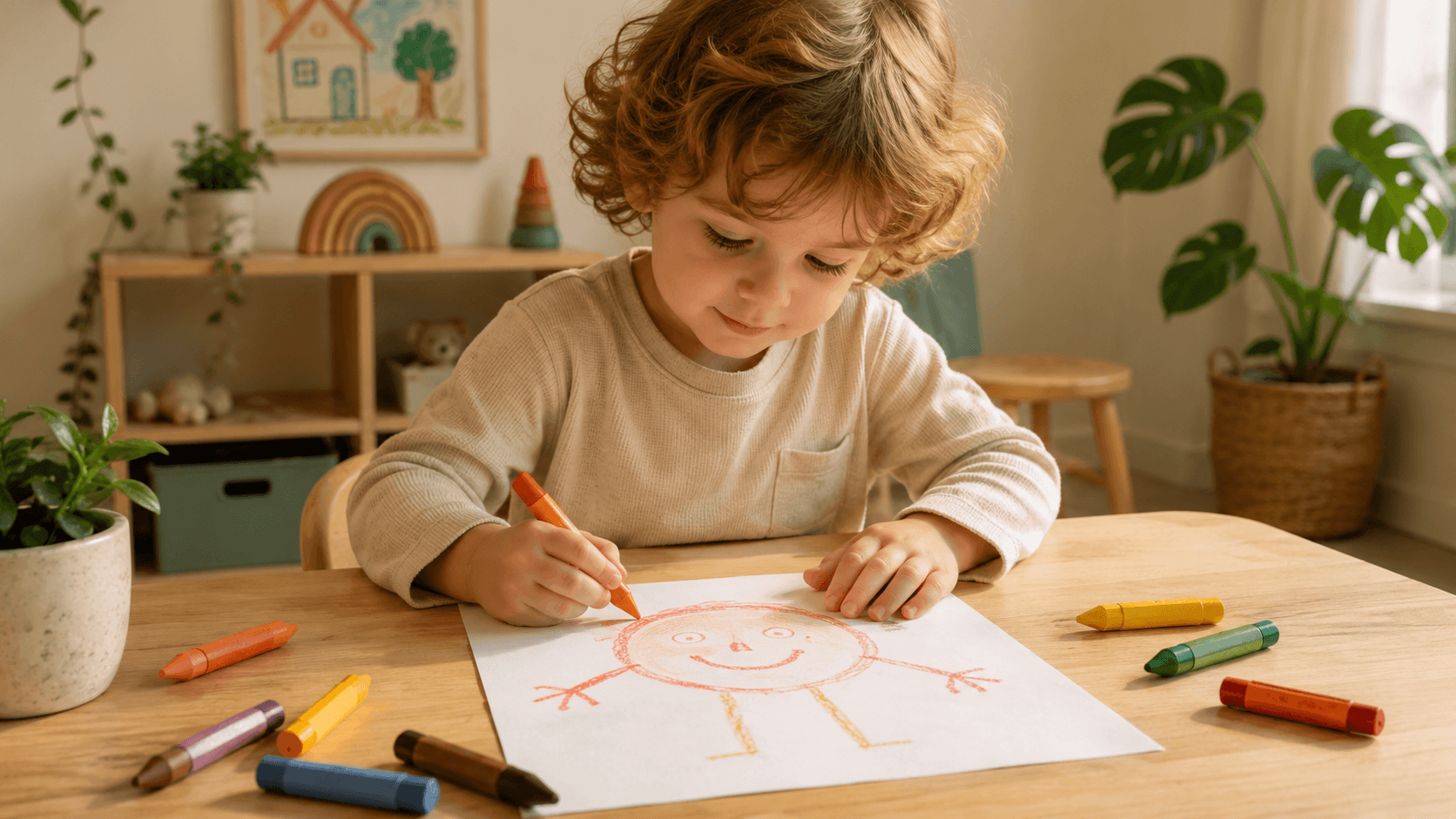
One of the most memorable early drawings is a large circle with eyes, a mouth, and legs coming straight out of the head.
Parents sometimes wonder why the body is missing.
In many cases, the answer is simple: drawing people develops gradually.
Early People Drawings Are Often Simple
Young children usually do not begin by drawing a complete human figure.
They experiment with marks, circles, lines, and familiar features.
A head may be the most noticeable part of a person, so eyes, a mouth, arms, and legs can appear before a separate body does.
Drawing Skills Develop Step by Step
As children gain practice, their people drawings often become more detailed.
Bodies, fingers, hair, clothing, and other features may appear over time.
Our guide to drawing development at age three explains some of the early changes parents may notice.
A Missing Body Is Not a Hidden Message
It can be tempting to interpret missing parts symbolically.
But a child may leave out a body because of age, drawing experience, attention, space on the page, or simple preference.
One picture cannot explain why a detail is missing.
Ask About the Person
Instead of asking, “Why didn’t you draw a body?” try “Tell me about this person.”
The child may have a complete story that has nothing to do with the structure of the figure.
What Parents Can Do
- Keep plenty of drawing materials available.
- Avoid correcting the child’s figure.
- Save drawings to notice development over time.
- Ask about the story rather than testing drawing accuracy.
Key Takeaways
- Simple human figures are common in early drawing development.
- Children add body parts and details gradually.
- A missing body does not have one fixed meaning.
- Practice and time usually bring more complex figures.
Frequently Asked Questions
What are head-and-leg people drawings?
They are early human figures where facial features and limbs are attached to a large head shape, sometimes without a separate torso.
Should I teach my child to add a body?
You can draw together, but there is usually no need to correct ordinary early drawings. Free practice supports development.
When do people drawings become more detailed?
There is wide variation. Details generally increase with age, experience, interest, and growing fine-motor skills.