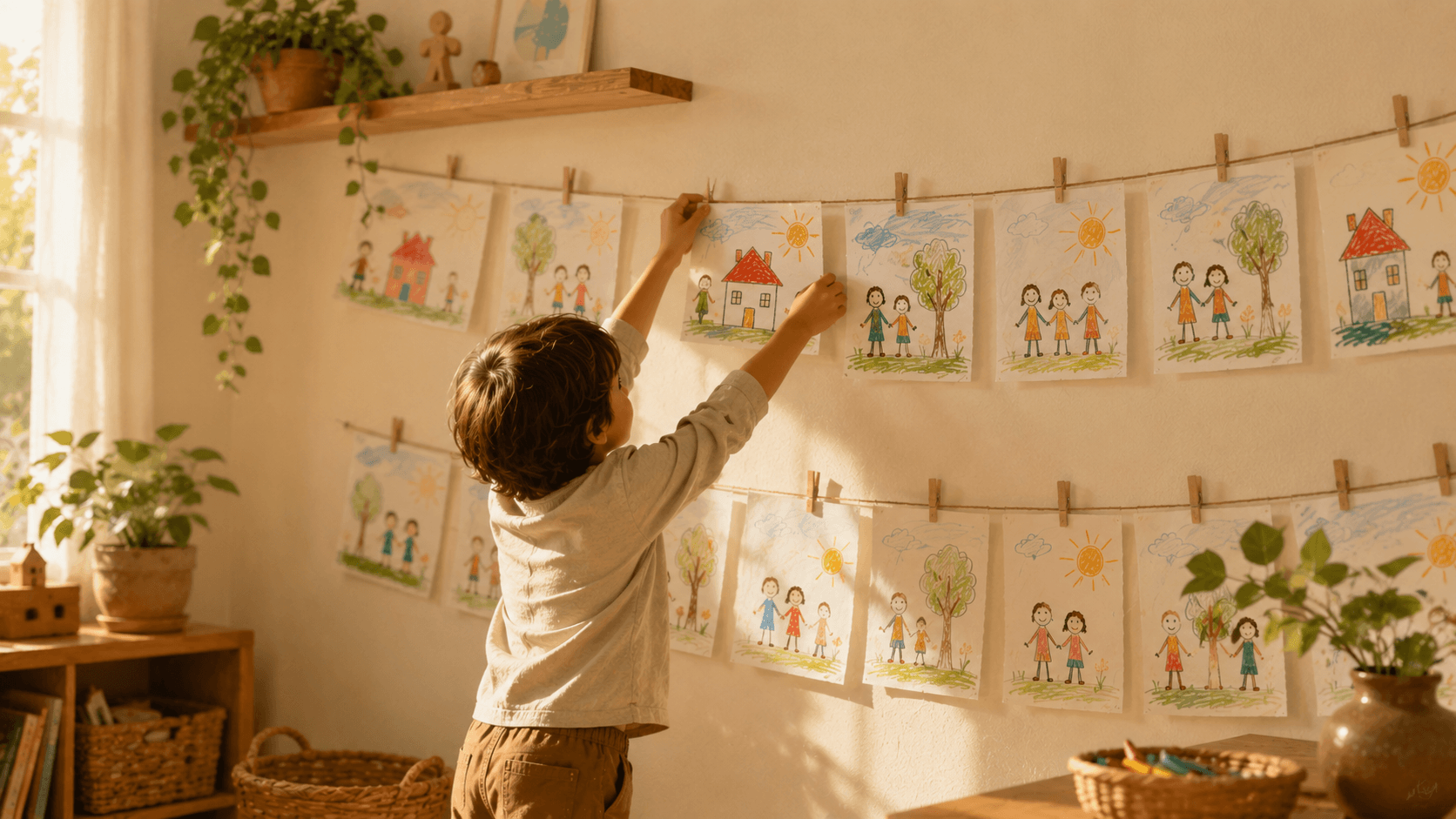
One drawing can make a parent pause.
Maybe your child draws the same house every week. Maybe people suddenly look smaller. Maybe darker colors appear more often than before.
It is tempting to look at one picture and ask, “What does this mean?”
But with children’s drawings, one picture is usually only a small piece of the story.
Patterns matter more.
One Drawing Is a Moment
A child’s drawing can be influenced by many simple things.
They may be tired. They may be copying something they saw. They may be trying a new idea. They may have chosen a color because it was nearby.
That does not make the drawing meaningless. It just means we should be careful about giving it too much weight.
A single drawing is like one page from a diary. It can be interesting, but it does not explain the whole book.
Patterns Show What Repeats
When you save drawings over time, you may begin to notice patterns.
For example:
- Favorite subjects
- Repeated characters
- More detailed people
- New stories appearing
- Changes in color choices
- More confidence with shapes and space
These patterns can help you understand your child’s interests and development in a calmer way.
Instead of asking, “Why did they draw this today?” you can ask, “What keeps showing up over time?”
Repetition Is Often Normal
Many children repeat the same drawing subjects.
Some draw animals again and again. Some draw houses. Some draw monsters, hearts, rainbows, or family scenes.
Repetition is often how children practice.
They learn where to place lines, how to build a shape, and how to add more details. The drawing may look similar to an adult, but the child may be improving something small each time.
Change Can Be Interesting Too
Patterns are not only about repetition.
Changes can be worth noticing as well.
Maybe a child starts adding people where they used to draw only objects. Maybe their drawings begin to include more stories. Maybe they add backgrounds, weather, or emotions.
These changes may simply reflect growth.
As children get older, their drawings often become more detailed and more connected to stories.
What Parents Can Do
You do not need a complicated system.
Try this:
- Keep a folder for drawings
- Take photos of artwork before it gets recycled
- Write the date on the back
- Ask your child to describe the picture
- Look back every month or two
This creates a gentle record of creative development.
It also helps you avoid overreacting to one drawing.
A Simple Question to Ask
When looking across several drawings, ask:
“What seems to matter to my child right now?”
This question keeps the focus on curiosity.
It might reveal an interest in animals, school, family, superheroes, nature, or pretend play.
Sometimes that is the most meaningful insight of all.
Key Takeaways
- One drawing is only a moment.
- Patterns over time are usually more helpful.
- Repeated subjects are often part of learning.
- Changes in detail and storytelling can show growth.
- Saving drawings helps parents observe calmly.
Children’s drawings do not need to be decoded like a puzzle. Sometimes, they are best understood as a growing collection of small stories.