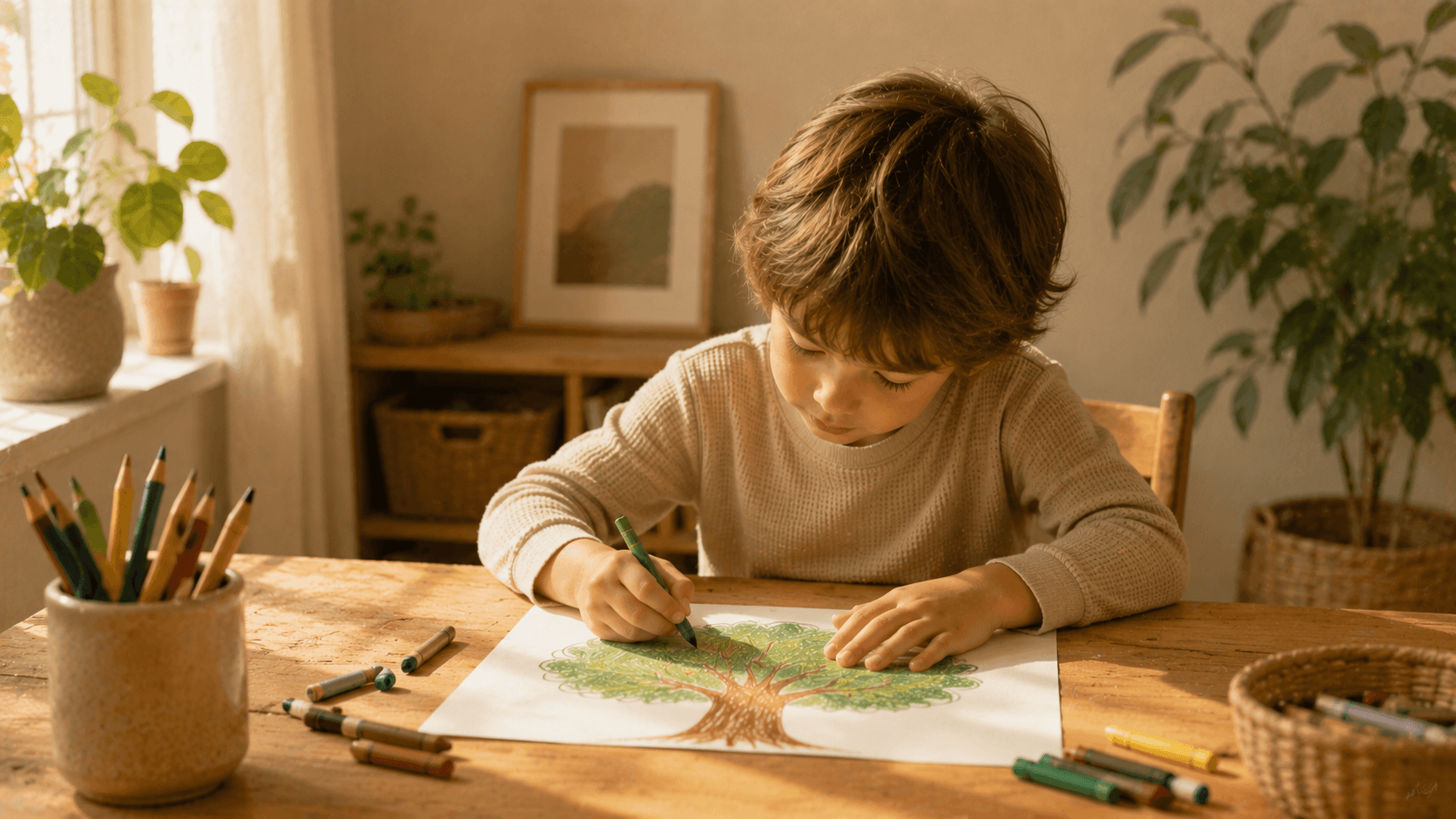
Trees show up often in children’s drawings.
Sometimes they are tall and colorful. Sometimes they are small, simple, or placed next to a house. Some children draw trees with fruit, flowers, birds, or swings.
Parents may wonder whether a tree has a special meaning.
The honest answer is: it depends.
A tree can be part of a story, a nature scene, a memory, or simply something a child enjoys drawing.
Why Children Draw Trees
Trees are familiar.
Children see them in parks, gardens, schoolyards, books, and cartoons. They are also easy to build from simple shapes: a line for the trunk, a circle or cloud shape for the leaves.
For many children, drawing a tree is a way to practice structure.
A trunk. Branches. Leaves. Maybe apples or birds.
It gives them something clear to build.
Look at the Whole Scene
A tree by itself may not tell you much.
But the scene around it can be interesting.
Is the tree next to a house? Are people playing nearby? Is there a swing? Are there animals, flowers, or sunshine?
The surrounding details often say more about the child’s story than the tree alone.
For example, a tree beside a house may simply be part of a familiar outdoor scene. A tree with birds may reflect an interest in nature. A tree with a swing may come from a memory of a playground.
What If the Tree Is Very Big?
Some children make a tree the largest part of the page.
That may mean the tree was the main idea of the drawing. It may also mean the child enjoyed adding details like branches, leaves, fruit, or animals.
A large tree does not need to be treated as a sign of anything specific.
Children often make favorite objects bigger because they are fun to draw.
What If the Tree Has No Leaves?
Adults may notice missing details.
But children often leave things out because of age, time, attention, or drawing skill.
A tree without leaves might be a winter tree. It might be unfinished. It might simply be how the child decided to draw it.
Before assuming anything, it is better to ask:
“Can you tell me about this tree?”
The answer may be much simpler than expected.
What Parents Can Do
Try asking gentle questions:
- “Where is this tree?”
- “What kind of tree is it?”
- “Does anyone play near it?”
- “What season is it in your picture?”
These questions invite storytelling without making the child feel analyzed.
Key Takeaways
- Trees are common and familiar subjects in children’s drawings.
- A tree may reflect nature, memory, storytelling, or practice.
- The scene around the tree matters more than the tree alone.
- Missing details are not automatically meaningful.
- Asking the child often gives the clearest context.
A tree in a child’s drawing is often just one part of a bigger world they are building on the page.