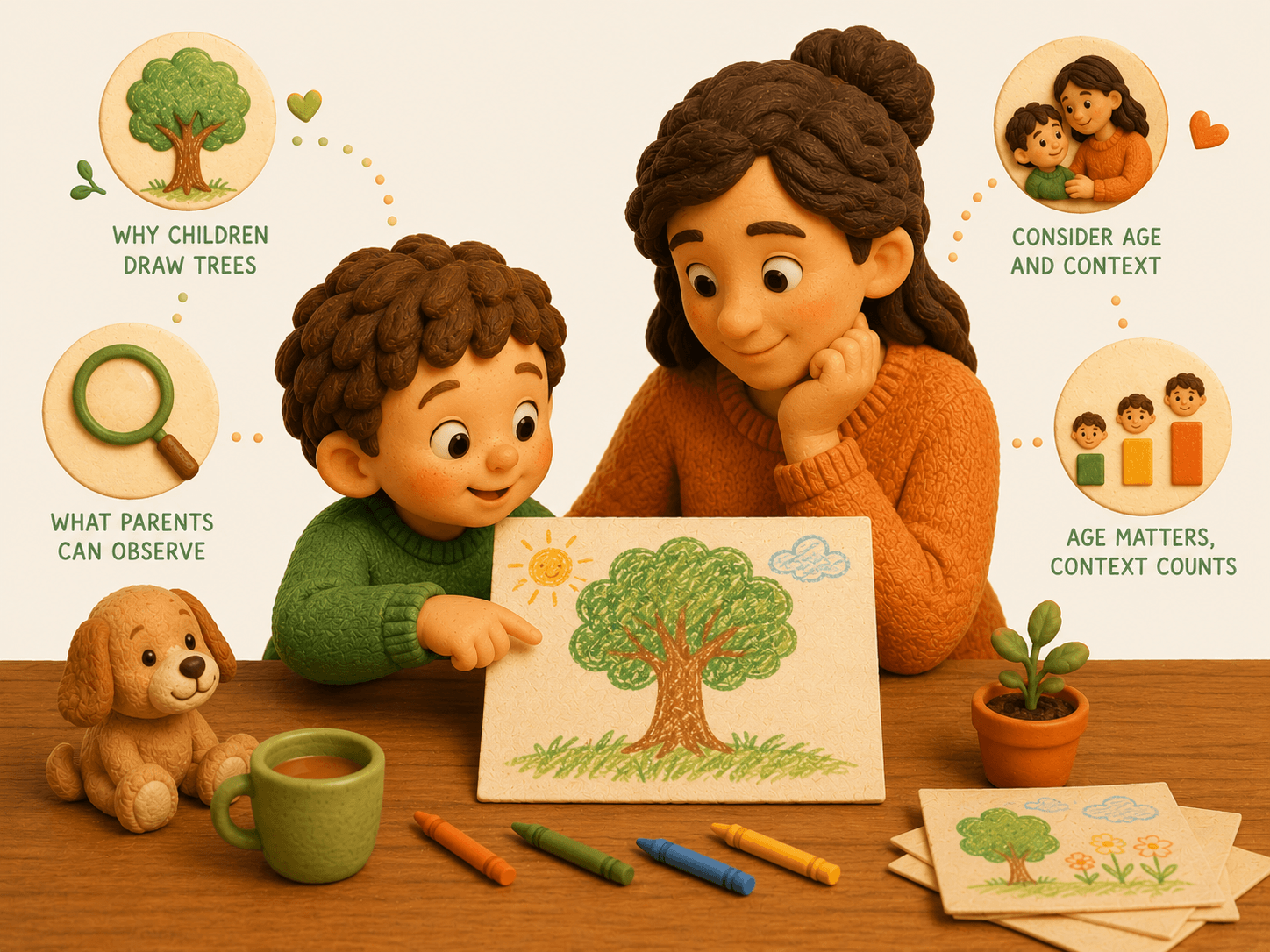
Trees appear in many children’s drawings. Sometimes they stand beside a house. Sometimes they fill the whole page. Sometimes they have apples, flowers, birds, or a swing hanging from a branch.
Parents may wonder whether a tree has a special meaning.
The simple answer is that a tree can mean many things, but it often starts as something familiar from the child’s world.
Children see trees in parks, gardens, schoolyards, books, and cartoons. Trees are also fun to draw because they can be simple or detailed. A child can make a tree with just a trunk and a round top, or they can add branches, leaves, fruit, animals, and a whole scene around it.
What a tree may reflect:
- Interest in nature
- A scene from daily life
- Practice with shapes and lines
- Imagination and storytelling
- A favorite place, such as a garden or park
The meaning depends on the full drawing.
Instead of focusing only on the tree, look around it:
- Is there a house nearby?
- Are people included?
- Is the tree part of a park or garden?
- Are animals or birds present?
- Does your child tell a story about it?
The surrounding details often matter more than the tree alone.
Parents sometimes search for meanings behind tree size, branches, roots, or missing leaves. It is better to be careful with these ideas. A small tree does not automatically mean one thing. A tree without leaves may simply be a winter tree. A tree with many branches may just be fun to draw.
Age also matters. Younger children may draw simple trees because they are still learning shapes. Older children may add details, depth, and stories.
What parents can do:
- Ask your child about the tree
- Notice whether trees appear often
- Save drawings over time
- Avoid interpreting one detail too strongly
- Look at the whole scene, not just the object
Try asking:
- “Where is this tree?”
- “What kind of tree is it?”
- “Who is near the tree?”
- “What is happening in this picture?”
Children often have a simple and charming explanation.
If your child draws trees repeatedly, it is usually not a concern. Many children repeat subjects they enjoy. Repetition can be practice, comfort, or a favorite theme.
Key takeaways:
- Trees are common in children’s drawings.
- They may reflect nature, daily life, or storytelling.
- Details like size or leaves should not be overinterpreted.
- Age and context matter.
- Asking the child is more helpful than guessing.
A tree drawing can be a small window into what your child notices and enjoys. The most helpful response is curiosity, not pressure to find a fixed meaning.