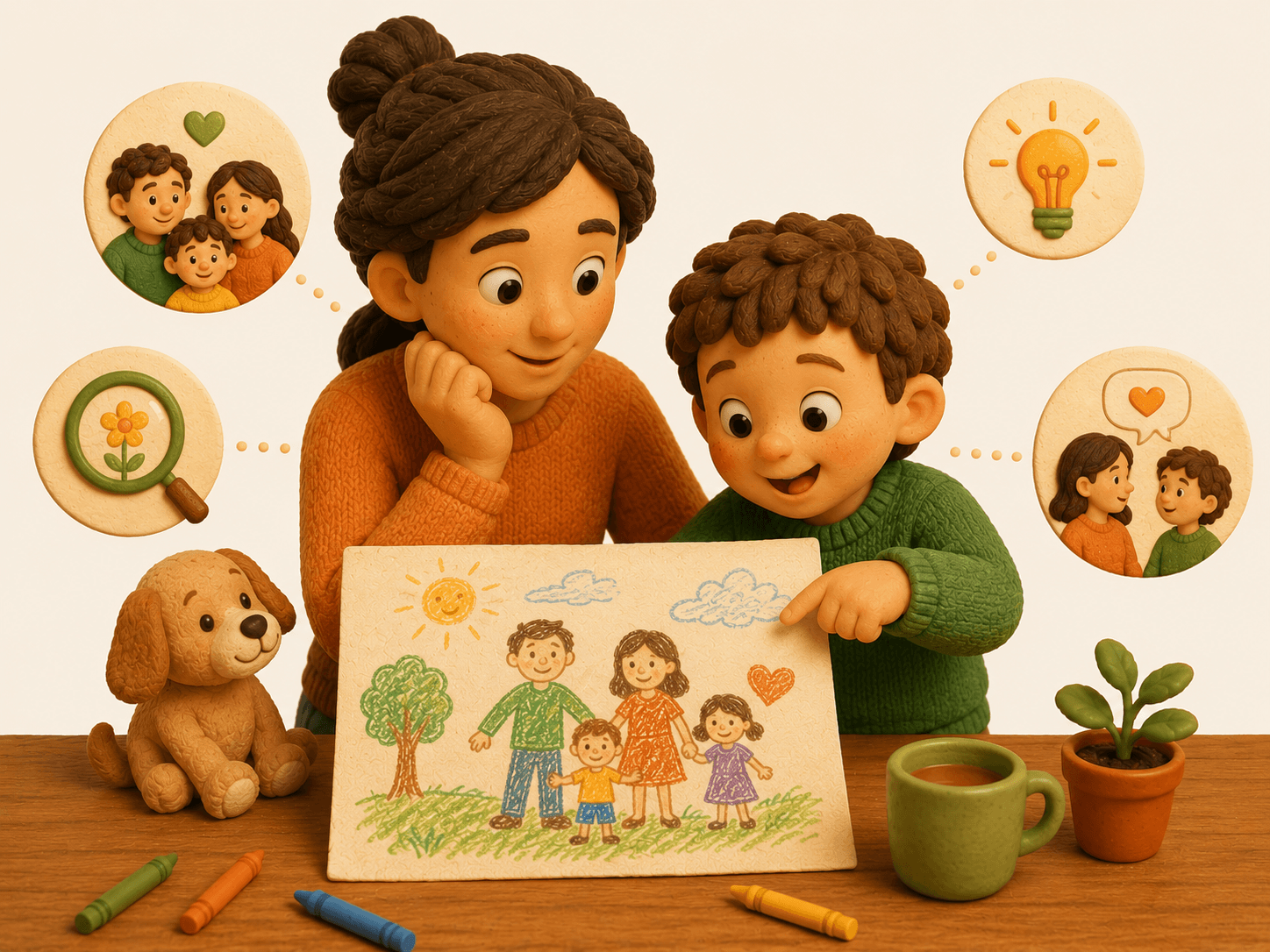
Family drawings are some of the most meaningful pictures parents receive.
A child may draw parents, siblings, grandparents, pets, or even imaginary family members. Sometimes everyone is smiling. Sometimes one person is much bigger. Sometimes someone is missing.
It is natural to wonder what these choices mean.
But family drawings should be approached gently. A child’s picture is not a diagnosis, a report, or a complete explanation of family life. It is usually a small story created in that moment.
Children draw family members for many simple reasons:
- Family is familiar
- People are part of daily life
- Children like drawing faces and bodies
- They may be telling a story about something that happened
- They may simply be practicing people drawings
Instead of asking “What does this mean?”, try asking “What is happening in this picture?”
That small shift can change everything.
Things parents can observe:
- Who is included in the drawing?
- What are the people doing?
- Are there places like a house, garden, or school?
- Does your child explain the picture happily?
- Do family drawings change over time?
It is important not to jump to conclusions if someone is missing. A child may leave out a person because they ran out of space, got distracted, or simply focused on another part of the story.
The same is true for size. A large person does not automatically mean that person is more important or more powerful. Children often draw people larger because they started with that figure, like that person, or wanted to add more details.
A better way to understand family drawings is to let the child explain them.
You can ask:
- “Can you tell me who is in the picture?”
- “What are they doing?”
- “Where are they?”
- “What happened before this?”
- “What happens next?”
These questions invite the child to share without feeling judged.
If your child often draws family pictures, you can save them and look at how they change over time. Maybe people become more detailed. Maybe new family members appear. Maybe the scenes become more story-based.
Those changes can be beautiful signs of growing expression and imagination.
When should parents pay closer attention? It may be worth noticing if drawings change suddenly and those changes appear alongside behavior changes, sadness, fear, or difficulty communicating. Even then, the drawing is only one piece of a bigger picture.
Key takeaways:
- Family drawings are common and often meaningful to children.
- Missing people or unusual sizes should not be interpreted too quickly.
- The child’s explanation matters more than adult assumptions.
- Patterns over time are more helpful than one picture.
- Open questions create better conversations.
A family drawing can be a lovely invitation to listen. Sometimes the best response is not to analyze it, but to sit beside your child and ask, “Tell me about this.”