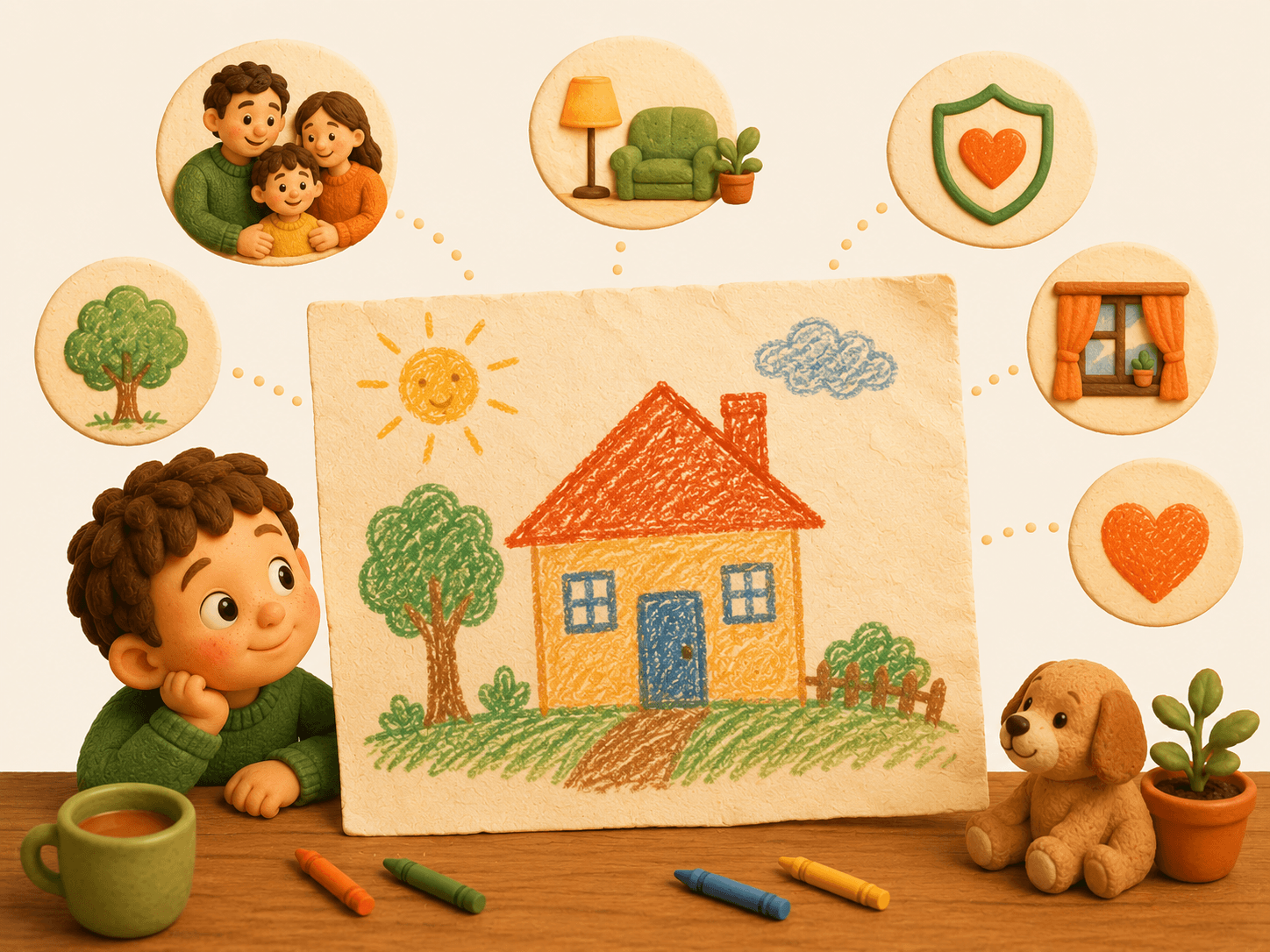
If your child enjoys drawing, you have probably seen a lot of houses.
Sometimes it is a simple square with a triangle roof. Sometimes it is a colorful home with windows, flowers, pets, and family members standing outside.
After seeing the same thing a few times, many parents start wondering: “Is my child trying to tell me something through this drawing?”
The short answer is: maybe, but not in the dramatic way many websites suggest.
A house is often just a familiar place. Children usually draw things they know well: their family, their pet, their favorite toy, their school, or their home. A house is also one of the easiest recognizable objects to draw because it can be made with simple shapes.
For many children, the house is not a hidden symbol. It is simply the setting for a story.
Instead of focusing only on the house, look at what is happening around it.
You might notice:
- Are there people near the house?
- Are there pets, trees, or flowers?
- Is the house part of a bigger story?
- Does your child draw the same house often?
- Has the drawing changed over time?
These small details may tell you more than the house itself.
What if your child draws houses all the time? In most cases, repetition is completely normal. Children often repeat subjects they enjoy or feel confident drawing. Some children draw dinosaurs for months. Others draw rainbows, animals, cars, or princesses. Some draw houses.
Repeating a favorite subject can be part of learning. It may help a child practice shapes, add new details, and build confidence.
Parents sometimes notice that a house is very large or very small. Size can be interesting to observe, but it should not be interpreted too quickly. A large house may simply be the main part of the story. A small house may mean the child focused on something else or started drawing in a different part of the page.
One drawing rarely gives enough information to understand why a child made a choice.
What parents can do:
- Ask your child to tell you about the picture
- Avoid guessing the meaning too quickly
- Save drawings over time
- Notice repeated themes
- Celebrate the effort and creativity
You could ask:
- “Who lives in this house?”
- “What is happening here?”
- “What happens next?”
- “What is your favorite part of this drawing?”
Sometimes the answer will be very simple: “It is just a house.”
Key takeaways:
- Houses are one of the most common things children draw.
- A house is often a familiar place, not a hidden symbol.
- Repeated house drawings are usually normal.
- The full drawing matters more than one object.
- Asking the child is usually more helpful than guessing.
A single drawing is a moment. A collection of drawings can tell a richer story over time.