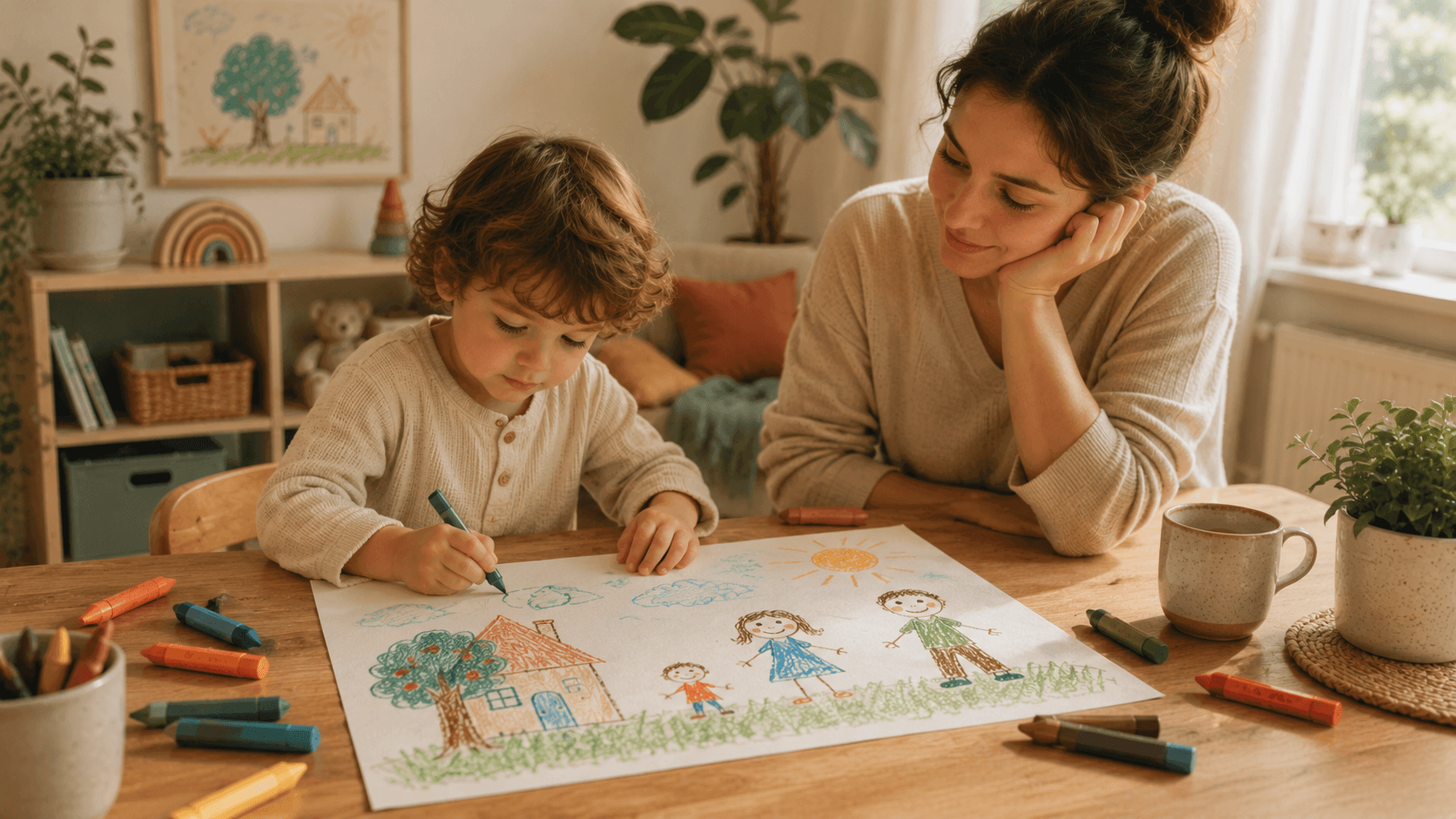
A tiny person in the corner of a large page can catch a parent’s attention.
Does the size mean something important?
Sometimes size is interesting to notice, but it should not be treated as a simple code.
Children Choose Size for Many Reasons
A person may be small because the child started with another part of the picture, wanted to fit many things on the page, was drawing someone far away, or simply enjoys making small figures.
Age and drawing skill matter too.
Look at the Whole Scene
Before focusing on one small figure, notice the rest of the picture.
Is it a busy scene? Are other objects small too? Is the person standing far away in the child’s story?
The whole composition usually provides more context than one feature.
Compare Patterns, Not One Picture
If you are curious, save drawings and see whether figure size changes over time.
This is more useful than interpreting one isolated picture.
Read more about why drawing patterns matter more than one picture.
Let the Child Explain
Try asking, “Who is this?” or “Tell me what is happening here.”
Avoid questions that suggest the child must feel small, lonely, or unimportant.
Those interpretations cannot be established from figure size alone.
What Parents Can Do
- Stay curious rather than worried.
- Ask open questions.
- Notice the whole drawing.
- Compare multiple drawings over time.
- Avoid assigning emotions based on size alone.
Key Takeaways
- Small people can appear for many ordinary reasons.
- Figure size has no single fixed meaning.
- Context and the child’s story matter.
- Patterns across drawings are more useful than one example.
Frequently Asked Questions
Does drawing oneself small mean low confidence?
You cannot determine confidence from figure size alone. Many practical and creative reasons can affect size.
What if one family member is always drawn smaller?
It may be worth asking the child neutrally about the picture and observing patterns, but avoid assuming a specific relationship meaning.
Should parents worry about tiny figures?
Usually not based on that detail alone. Consider the child’s broader behavior, development, context, and explanations.