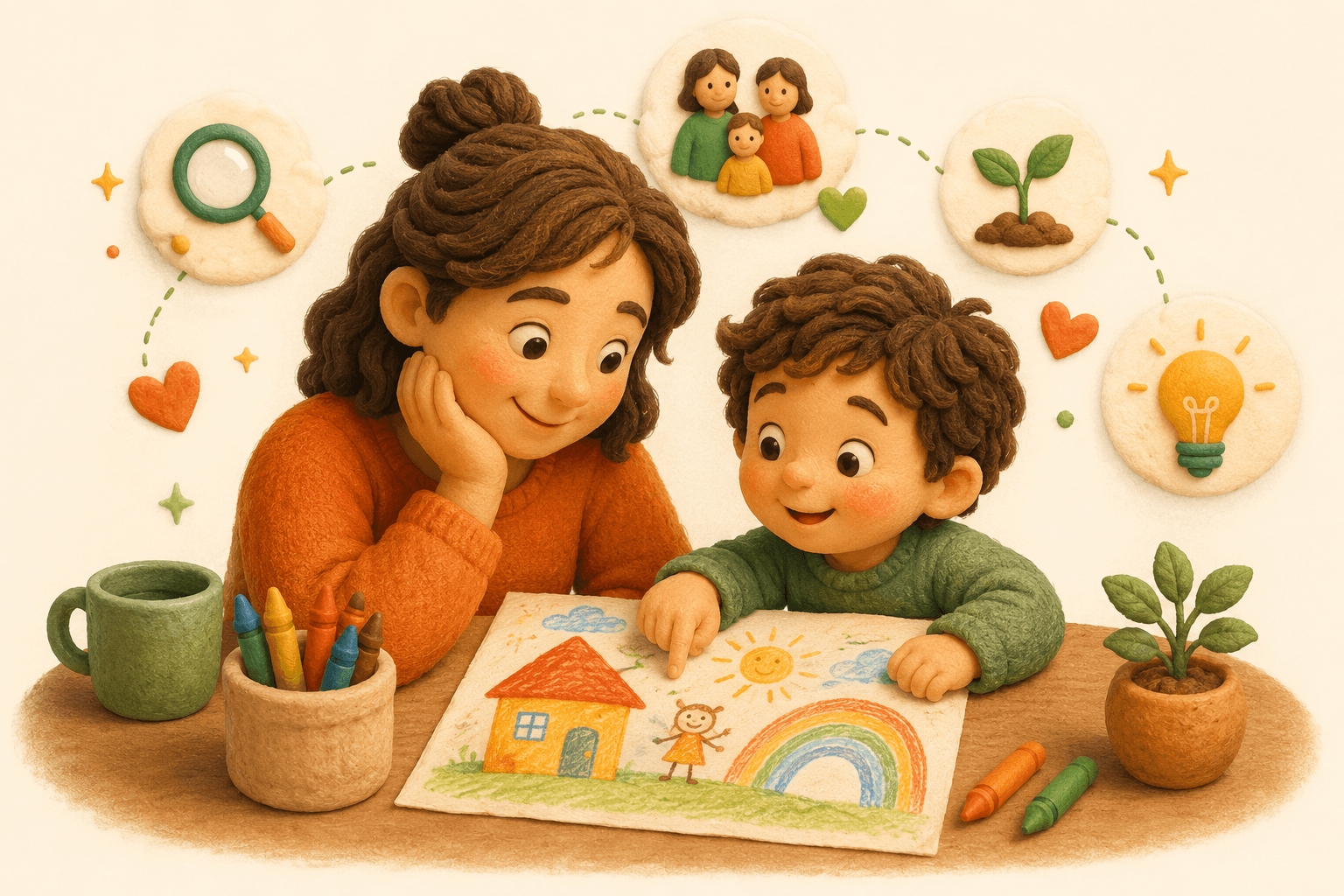
Children’s drawings can make parents curious.
A tiny person, a huge house, a dark sky, a repeated animal, or a family picture can all raise questions. It is natural to wonder what these drawings mean.
But the most helpful approach is usually not to interpret too quickly.
Children’s drawings are not puzzles that parents need to solve. They are creative expressions, stories, experiments, and sometimes just play.
A gentle way to interpret a drawing is to start with observation.
Step 1: Look at the whole picture
Before focusing on one detail, notice the full drawing. What is happening? Who is included? Is there a setting? Does the picture seem like a story?
One object rarely explains the whole drawing.
Step 2: Consider the child’s age
A 4-year-old and a 7-year-old may draw the same subject very differently. Younger children may use simple shapes. Older children may add details, scenes, and more storytelling.
Age matters because drawing skills grow over time.
Step 3: Ask the child
This is the most important step.
Instead of guessing, ask:
- “Can you tell me about this?”
- “What is happening here?”
- “Who is this?”
- “What happens next?”
- “What did you like drawing most?”
Children often give simple, surprising, or funny answers. Their explanation matters more than an adult’s assumption.
Step 4: Look for patterns
One drawing is just one moment. Patterns over time can be more useful.
You may notice:
- Favorite subjects
- New details
- Repeated stories
- Growing confidence
- Changes in color or theme
Saving drawings can help you see development more clearly.
Step 5: Avoid fixed meanings
Be careful with statements like “This always means…” or “That proves…”
A small person does not always mean insecurity. A dark color does not always mean sadness. A missing family member does not always mean something is wrong.
Children draw for many reasons, and context matters.
What parents can do:
- Stay curious
- Ask open questions
- Avoid dramatic reactions
- Praise effort and storytelling
- Keep drawings over time
- Let creativity stay playful
When should you pay closer attention? It may be worth observing more carefully if drawings change suddenly and those changes appear together with changes in behavior, mood, sleep, communication, or daily routines.
Even then, drawings are only one piece of the bigger picture.
Key takeaways:
- Start with observation, not interpretation.
- The child’s explanation is very important.
- Age and context matter.
- Patterns over time are more helpful than one drawing.
- Avoid turning every picture into a concern.
The best way to understand children’s drawings is to stay close, stay curious, and let the child tell the story first.