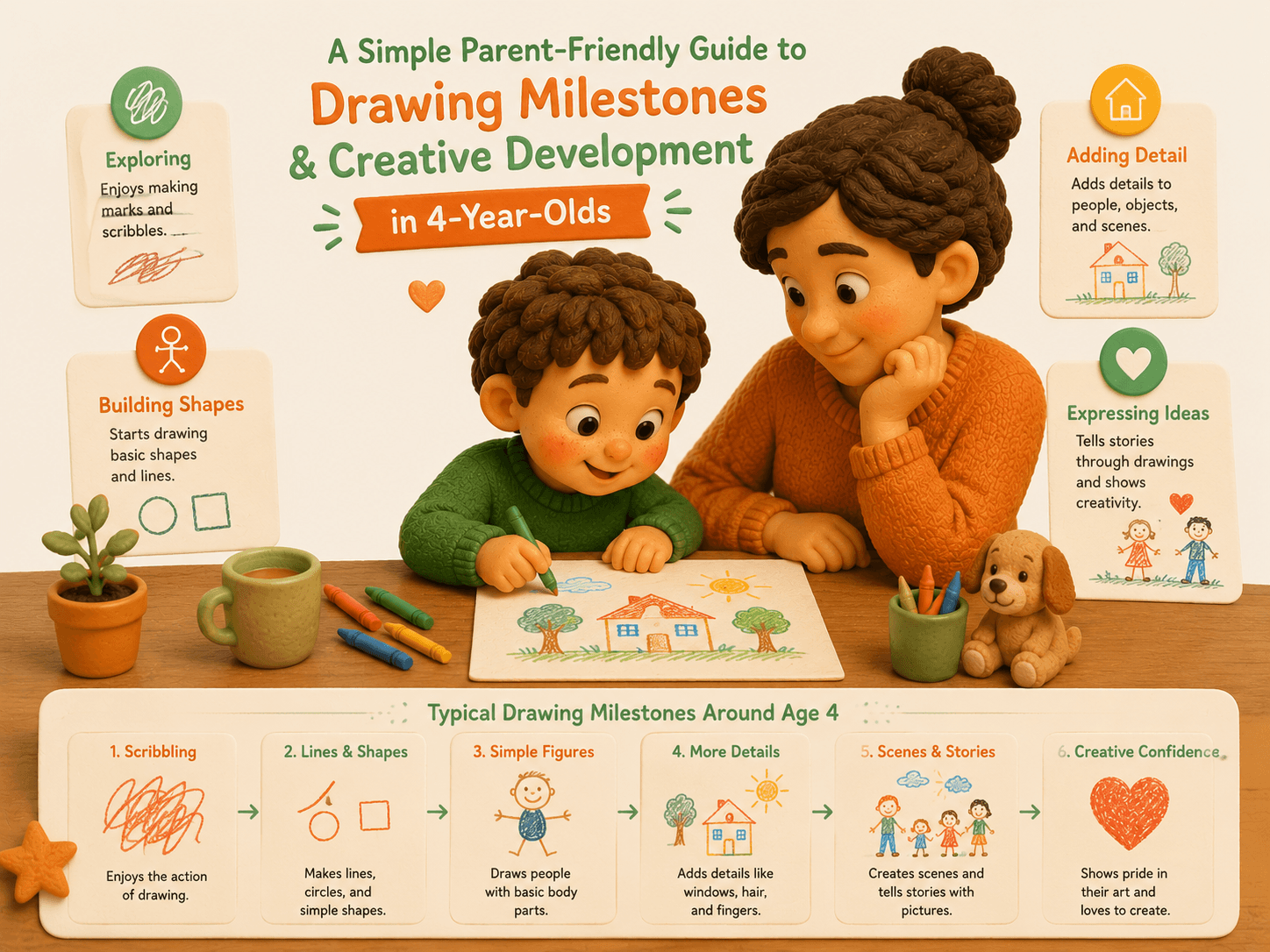
Around age five, many children begin adding more detail and intention to their drawings.
A person may now have hair, fingers, clothes, or facial expressions. A house may have windows, a door, a garden, and people standing nearby. Drawings may start to feel more like little stories rather than single objects.
This does not happen at the same speed for every child. Some five-year-olds draw often and confidently. Others are less interested. That difference can be completely normal.
At age five, children may begin to show:
- More recognizable people
- More details in houses and nature scenes
- Stronger storytelling
- Favorite repeated themes
- More intentional use of color
- Better control of lines and shapes
This is also an age when children may start explaining their drawings in more detail. They might say, “This is our house, and this is the dog, and we are going to the park.”
That story matters.
Parents sometimes compare drawings too quickly. But drawing is influenced by many things: interest, practice, fine motor skills, mood, and confidence. A child who draws every day may show more detail than a child who prefers outdoor play or building blocks.
What parents can notice:
- Are drawings becoming more detailed over time?
- Does your child tell stories about them?
- Do they repeat favorite subjects?
- Are they experimenting with colors?
- Do they seem comfortable drawing?
A five-year-old may draw the same thing many times. This can be a good sign. Repetition often helps children practice and feel proud of what they can create.
How to support drawing at this age:
- Offer different materials
- Let your child choose what to draw
- Ask open-ended questions
- Avoid correcting every detail
- Save drawings to notice progress
You might ask:
- “What is happening in this picture?”
- “Who is this?”
- “What is your favorite part?”
- “Can you tell me the story?”
These questions help children talk about their ideas without feeling tested.
When should parents be concerned? A single simple drawing is usually not a reason to worry. It may be worth paying attention if a child suddenly loses interest in many activities they used to enjoy, avoids using their hands in daily tasks, or seems very frustrated with drawing and other fine motor activities. Even then, drawing is only one part of the bigger picture.
Key takeaways:
- Five-year-olds often add more detail and storytelling.
- People, houses, family, animals, and nature scenes are common.
- Repetition is usually part of learning.
- Drawing development varies from child to child.
- Encouragement and curiosity are more helpful than correction.
At age five, drawings often become little stories. The best thing parents can do is listen to those stories with interest.