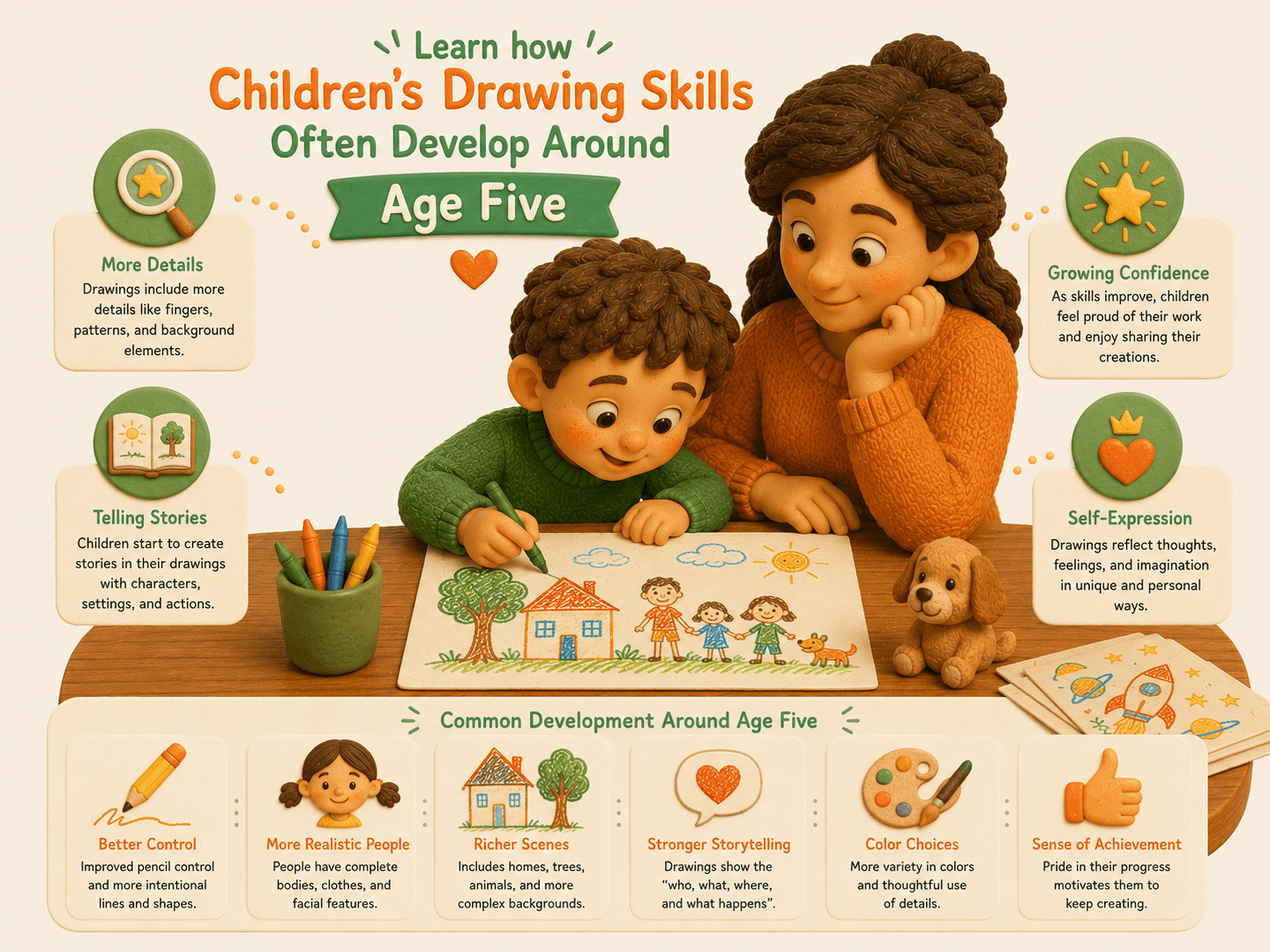
At age four, children’s drawings often begin to feel more recognizable.
You may start seeing people with heads, eyes, arms, and legs. Houses may have doors and windows. Animals may appear with ears, tails, or spots. The drawings may still look simple, but there is usually more intention behind them.
This is a lovely stage because children are not just making marks anymore. They are often trying to show ideas.
A 4-year-old may draw:
- People with basic body parts
- Simple houses
- Sun, clouds, and trees
- Favorite animals
- Family members
- Objects from daily life
Of course, every child develops differently. Some children love drawing and spend a lot of time practicing. Others prefer building, running, singing, or pretend play. Both can be perfectly normal.
At this age, drawings may still be very unrealistic. A person may have arms coming out of the head. A house may be floating. A dog may look like a circle with legs. That is part of the charm.
What matters most is not whether the drawing looks “correct.” It is whether the child is exploring, experimenting, and enjoying the process.
Parents can notice:
- Is your child starting to name what they draw?
- Are they adding more details over time?
- Do they tell stories about their pictures?
- Are they trying different colors and shapes?
- Do they seem proud of their work?
One helpful thing you can do is ask your child to explain the drawing. At age four, the story behind the picture is often more detailed than the picture itself.
Try asking:
- “Can you tell me about this?”
- “Who is in the picture?”
- “What is happening here?”
- “What did you draw first?”
Avoid asking too many correcting questions like “Why does the person have no body?” or “Why is the sun green?” Children are still learning how to represent the world, and creativity matters more than accuracy.
If you want to support drawing development, keep it simple:
- Offer paper and crayons
- Let your child draw freely
- Display or save favorite drawings
- Draw together sometimes
- Praise effort, ideas, and details
You do not need to turn drawing into a lesson. Free drawing is often enough.
Key takeaways:
- Four-year-olds often begin creating more recognizable drawings.
- Simple people, houses, animals, and nature scenes are common.
- Drawings may still be unrealistic, and that is normal.
- The child’s story can be more important than the picture itself.
- Encouragement is more helpful than correction.
At age four, drawing is less about making something perfect and more about learning how ideas can live on paper.
One Reply to “Drawing Development at Age 4: What Parents Can Expect”