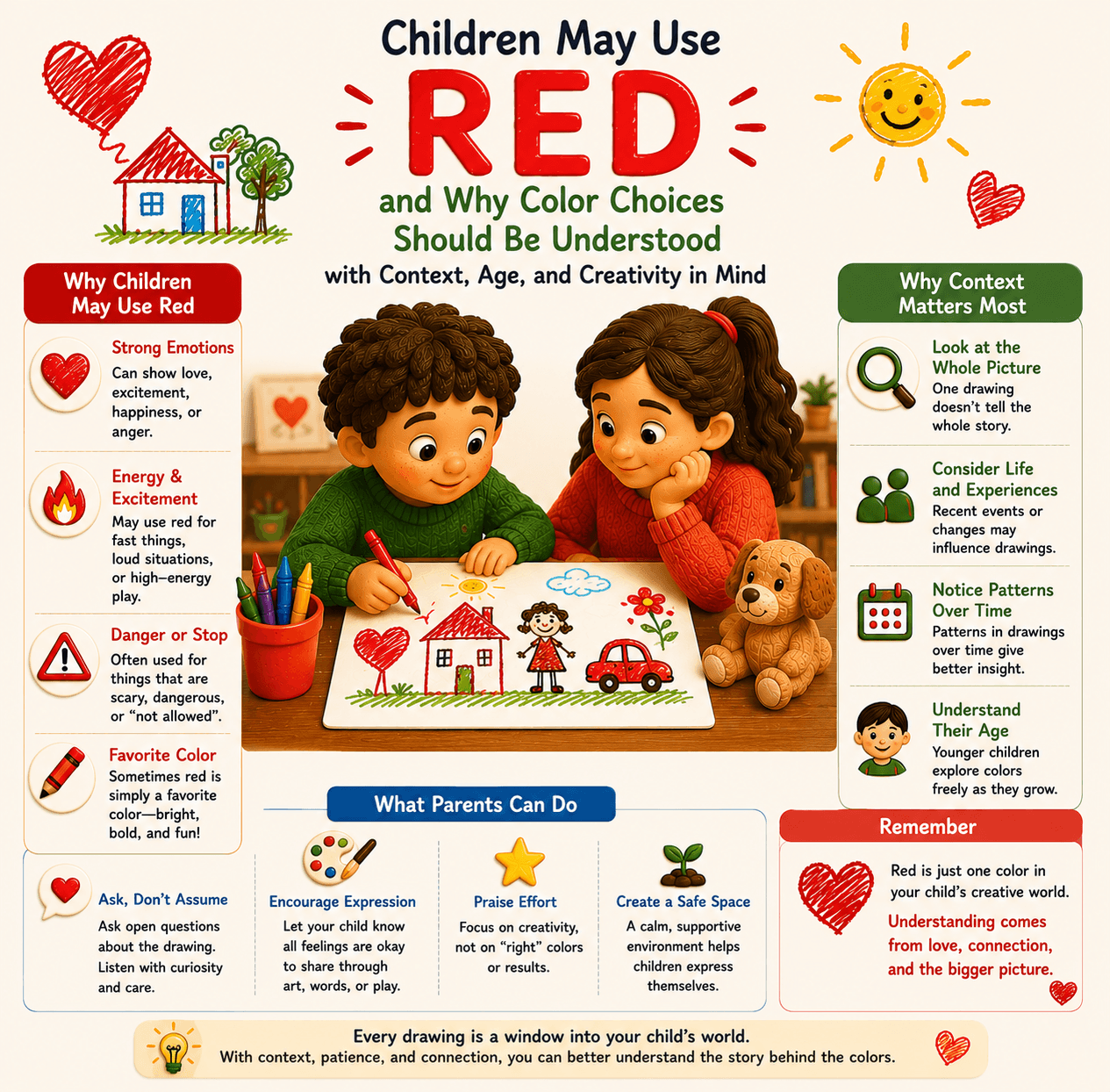
Red is a color parents often notice right away.
It is bright, strong, and hard to ignore. When a child uses a lot of red in a drawing, some parents start to worry. Does it mean anger? Excitement? Something emotional?
The careful answer is: red can mean many things, and it should not be interpreted too quickly.
Children use colors for all kinds of reasons. Sometimes they choose red because it is their favorite color. Sometimes because they are drawing apples, hearts, fire trucks, flowers, superheroes, or a sunset. Sometimes red is simply the crayon they picked first.
Color choice can be expressive, but it is not a code with one fixed meaning.
Red may be connected to:
- Energy
- Excitement
- Favorite objects
- Strong visual interest
- Storytelling
- Simple color preference
It may also appear in drawings with intense themes, but that does not mean the color itself is a warning sign.
Instead of focusing only on the color, look at the whole picture.
Ask yourself:
- What is the child drawing?
- Is red being used for a specific object?
- Does the child use red often?
- Are other colors included too?
- What does the child say about the drawing?
A child who draws a red house, a red heart, or a red dragon may have very different reasons for using the same color.
The best way to understand is to ask.
Try:
- “I see you used a lot of red. Tell me about it.”
- “What is happening here?”
- “Why did you choose this color?”
- “What is your favorite part?”
Keep your tone light. If a child feels that an adult is worried, they may become uncomfortable or change the way they draw.
Parents sometimes search for exact meanings behind colors. But children’s color use depends on age, available materials, mood, imagination, and preference. A young child may use unrealistic colors simply because they enjoy them. A green sun or red tree may be creative play, not a message.
What parents can do:
- Avoid assuming red means anger
- Ask your child about the drawing
- Notice repeated patterns over time
- Look at the full scene
- Support free color choices
When might color use be worth observing more closely? If you notice sudden, persistent changes in many drawings and those changes happen alongside behavior or mood changes, it may be worth paying attention. Still, the color itself should not be treated as proof of anything.
Key takeaways:
- Red is a strong and noticeable color.
- Children may use red for many simple reasons.
- Red does not automatically mean anger or distress.
- The full drawing matters more than one color.
- Asking the child is usually the best first step.
Color can be part of a child’s story, but it is rarely the whole story.